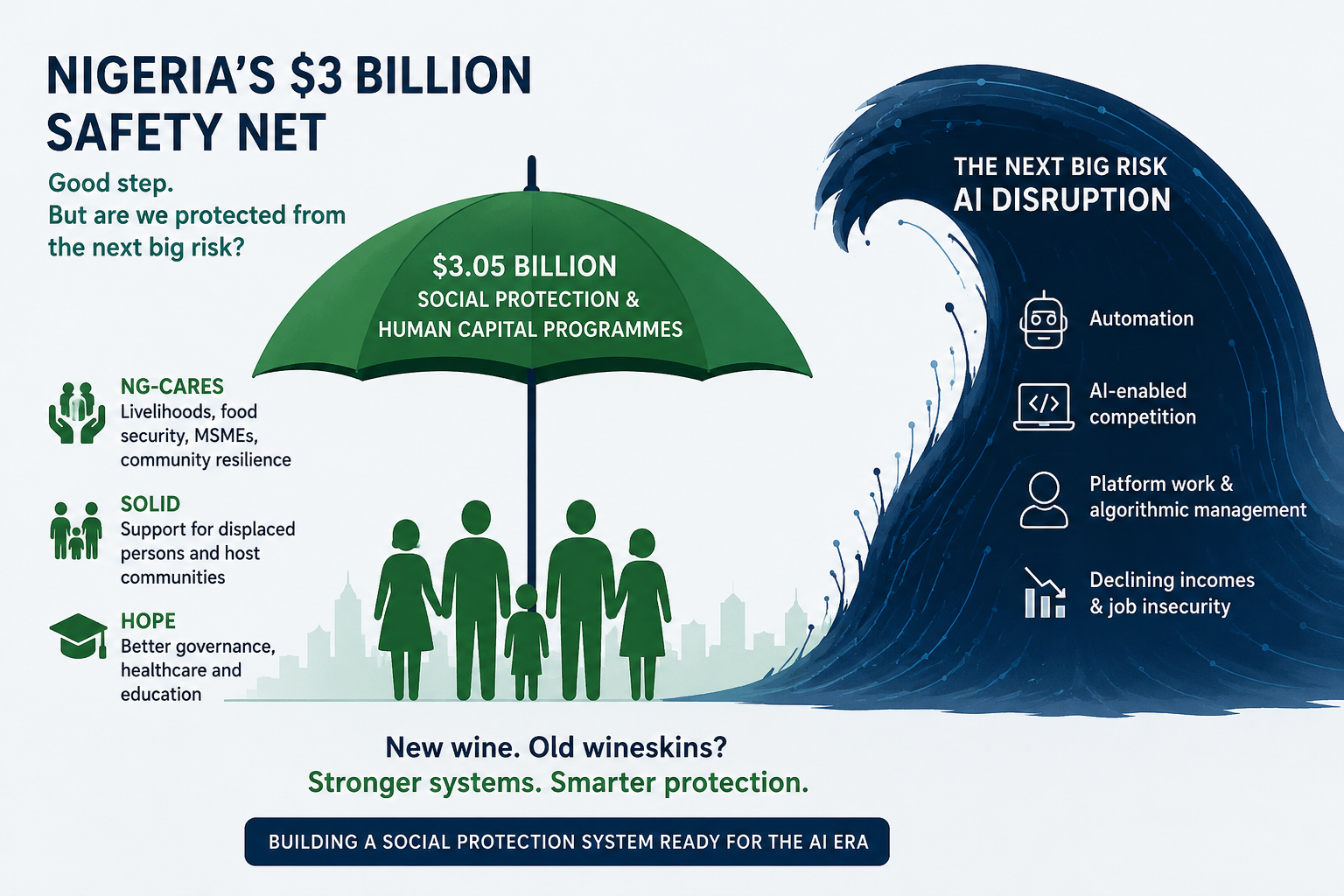
As I work on the preliminary pages of my PhD dissertation on Artificial Intelligence and Labour Market Risks in Nigeria, the Federal Government, on July 16, 2026, launched a US$3.05 billion, about ₦4.45 trillion, package of social protection and human capital programmes.
My first reaction was, this is good news!
Any serious investment in reducing poverty, strengthening livelihoods, improving healthcare, expanding education and supporting vulnerable Nigerians deserves recognition.
The new package, comprising NG-CARES Additional Financing, the SOLID programme, and the HOPE initiatives, signals that government understands that economic growth alone is not enough. People must be protected from shocks and given opportunities to thrive.
But as I read the details, another question kept bothering me.
Protected from which shocks?
The programmes are designed around the risks we already know: poverty, food insecurity, displacement, poor healthcare, weak education and community resilience. These are real and urgent problems. Yet, while we are strengthening yesterday's safety net, a new form of vulnerability is quietly emerging, one that barely features in our policy conversations.
Artificial intelligence is beginning to change how Nigerians earn a living.
This will not first appear as millions of people suddenly losing their jobs. In a country where over 90 per cent of workers earn their living in the informal economy, the first signs will be more subtle. A graphic designer loses clients to AI tools. A freelance writer sees assignments disappear. A trader loses customers to AI-enabled businesses. A call centre worker becomes less valuable. A young graduate discovers that the entry-level tasks that once opened doors into the labour market are now automated.
These people may never appear in unemployment statistics. They may never qualify for emergency assistance. Yet their livelihoods will be steadily eroded.
This is the problem my doctoral research seeks to understand.
The question is no longer whether Nigeria has social protection. Clearly, it does, and the new investment reinforces that commitment. The real question is whether our social protection architecture is being redesigned for the risks of the AI era.
Another issue deserves honest reflection.
Programmes do not change lives simply because they are well funded.
Nigeria has announced ambitious social intervention programmes before. Many have produced positive outcomes, but many have also struggled with weak targeting, political interference, fragmented beneficiary registers, leakages and implementation inefficiencies. Too often, the people most in need receive the least, while resources are diluted as they pass through multiple administrative layers.
That is why I worry that, unless governance and delivery systems are fundamentally strengthened, this new investment risks becoming new wine poured into old wineskins. The funding may be new, but if it continues to flow through the same structures that have historically limited impact, we should not expect dramatically different outcomes.
The challenge before us is bigger than distributing money. It is about building a social protection system that can detect new forms of vulnerability before families fall into poverty. It is about using better data, dynamic social registries, digital public infrastructure and labour-market intelligence to identify people whose livelihoods are changing long before they become destitute.
Nigeria has taken an important step.
The next step is ensuring that our safety nets evolve as quickly as the economy they are meant to protect.
That conversation has already begun in my PhD research, and I hope it becomes part of our national conversation as well.